Now Reading: Investing in Startups: A Beginner’s Guide to Opportunities and Risks
-
01
Investing in Startups: A Beginner’s Guide to Opportunities and Risks
Investing in Startups: A Beginner’s Guide to Opportunities and Risks


Startups have become one of the most exciting investment opportunities in today’s market, offering the potential for exponential returns. However, investing in early-stage companies requires an understanding of the fundamentals, associated risks, and ways to participate. This guide provides an overview of startup investments, their advantages, challenges, and practical steps for beginners.
What are Startups and Why Invest in Them?
A startup is an early-stage company designed to scale rapidly, often leveraging technology and innovation to disrupt industries. Unlike traditional businesses, startups prioritize growth over immediate profitability, making them attractive yet high-risk investments.
Key Reasons to Invest in Startups:
High Return Potential – Successful startups can generate substantial gains for early investors, as seen in companies like Airbnb and Uber.
Diversification – Investing in startups allows investors to expand their portfolios beyond stocks and real estate.
Innovation & Impact – Supporting groundbreaking ideas and industries shaping the future.

Risks and Rewards: Is Startup investing Worth It?
While startups offer significant upside, they come with inherent risks. Understanding these factors helps investors make informed decisions.
| Risk Factor | Potential Impact | Mitigation Strategies |
|---|---|---|
| High Failure Rate | Over 90% of startups fail within the first five years. | Diversify investments across multiple startups. |
| Lack of Liquidity | Startup shares are not publicly traded, making exits difficult. | Invest funds you can afford to hold long-term. |
| Valuation Uncertainty | Startup valuations are speculative and can fluctuate. | Focus on due diligence and financial projections. |
| Market & Regulatory Risks | Changes in industry trends or regulations can impact success. | Stay informed on emerging trends and policies. |
| Long Investment Horizon | Returns often take years to materialize. | Be patient and monitor startup progress. |
How to Start Investing in Startups with Limited Capital
New investors don’t need vast capital to start. Several accessible methods enable participation in startup investments.
Investment Paths for Beginners:
Convertible Notes & SAFEs – Instruments that allow investors to provide early-stage funding with conversion into equity at a later stage.
Equity Crowdfunding – Platforms like AngelList, Republic, and SeedInvest allow retail investors to buy equity in early-stage companies.
Startup Accelerator Funds – Investing in funds managed by startup accelerators provides indirect exposure to multiple startups.
Venture Capital Syndicates – Partnering with experienced angel investors to co-invest in vetted opportunities.
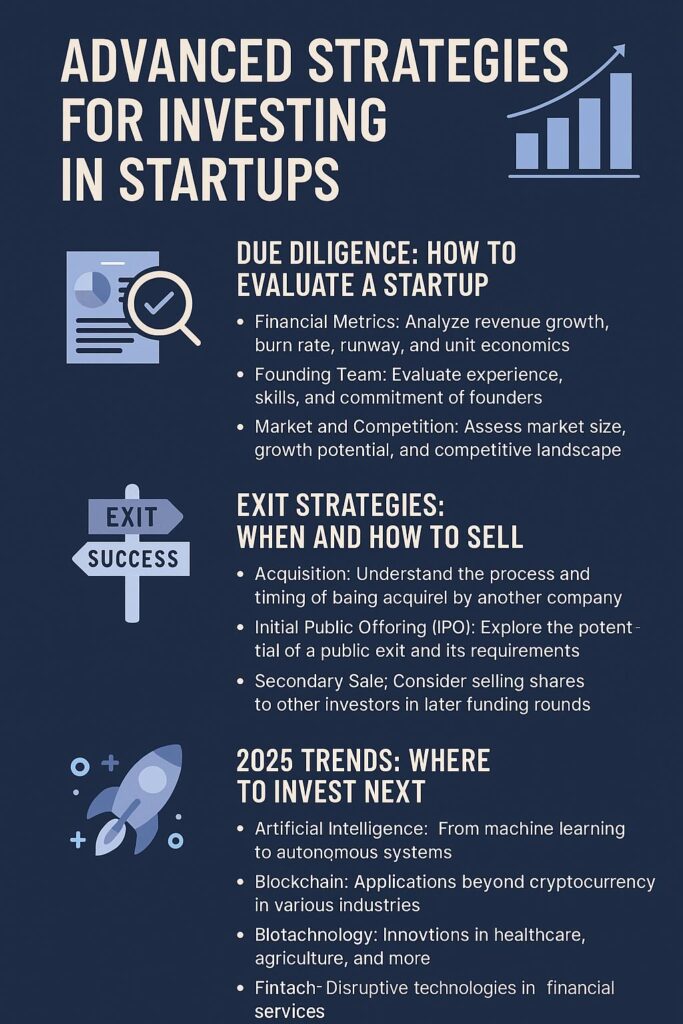
Due Dilegence: How to Evaluate a Startup Before Investing
For seasoned investors, the evaluation process goes beyond passion and vision. It requires thorough due diligence to assess viability and growth potential.
Key Areas of Due Diligence:
Founding Team: Assess experience, execution ability, and complementary skills.
Market Opportunity: Validate market size, growth trends, and demand.
Product-Market Fit: Ensure the product solves a real problem with traction to back it up.
Financial Health: Analyze burn rate, runway, revenue models, and existing cap table.
Legal & IP: Review intellectual property rights, compliance, and regulatory environment.
“Big ideas start small — investing in startups today is betting on the giants of tomorrow.” André Rangel
Exit Strategies: When and How to Cash Out
A startup investment only becomes profitable when you realize a return. Understanding possible exit paths is essential.
Common Exit Scenarios:
Acquisition: A larger company buys the startup.
IPO: The company goes public and sells shares on the stock exchange.
Secondary Sales: Selling your shares to other investors in private markets.
Buybacks: In rare cases, the startup repurchases your shares.
2025 Trends: Where Are the Best Startup Opportunities?
Hot Sectors in 2025:
Artificial Intelligence & Automation – AI-powered platforms are disrupting industries from customer service to logistics.
GreenTech & Sustainability – Climate-focused startups are gaining investor interest as ESG grows in influence.
Web3 & Decentralized Finance – Blockchain-based platforms continue to redefine financial ecosystems.
HealthTech & Biotech – Innovation in diagnostics, remote care, and genomics is accelerating.
Analyzing these sectors early and understanding the regulatory outlook will help position your capital for long-term growth.
Vision Overview: Maturing as a Startup Investor
As your expertise evolves, your approach should become more data-driven and strategic. From building your own syndicate to leading funding rounds, seasoned investors have the power to shape innovation at its core. The key is staying vigilant, leveraging networks, and aligning capital with trends and talent.
Continue investing not just in companies—but in the future itself.
Stay Informed With the Latest & Most Important News
Previous Post
Next Post







Advertisement