Now Reading: 3 Millimeters to Global Supremacy: The AI Semiconductor Race
-
01
3 Millimeters to Global Supremacy: The AI Semiconductor Race


Artificial Intelligence (AI) is transforming industries worldwide, from autonomous vehicles to advanced data analytics. However, one of the key enablers of AI’s rapid growth is the semiconductor industry, which is under pressure to innovate faster than ever. With increasing demand for high-performance, energy-efficient AI chips, investors and businesses have a unique opportunity to capitalize on this evolving market.
1 – The Rising Demand for AI Semiconductors
The AI semiconductor market is experiencing explosive growth, driven by:
AI-powered data centers
Autonomous systems (vehicles, robotics)
Edge computing and IoT devices
Cloud-based AI services
Market Size And Forest
| Year | Market Size (USD Billion) | Growth Rate (%) |
|---|---|---|
| 2024 | 70 | 18 |
| 2025 | 85 | 21 |
| 2030 | 250+ | 25+ |
The market is projected to surpass $250 billion by 2030, making it one of the fastest-growing sectors in the technology space.
2 – Key Materials and Manufacturin Process
The foundation of AI chips lies in their raw materials and fabrication processes. High-performance AI chips require:
Essential Materials
| Material | Function |
| Silicon | Core component for transistors |
| Gálio & Germânio | Improves conductivity & efficiency |
| Carbide (SiC) & Nitreto de Gálio (GaN) | Boosts power efficiency |
| Rare Metals (Tantalum, Tungsten, Cobalt) | Used for circuit connections |
Fabrication Process:
Wafer Production – Refining silicon into ultrapure wafers.
Photolithography – Using extreme ultraviolet (EUV) to etch microscopic circuits.
Deposition & Etching – Layering and shaping materials for optimal conductivity.
Testing & Packaging – Ensuring chip efficiency and durability.
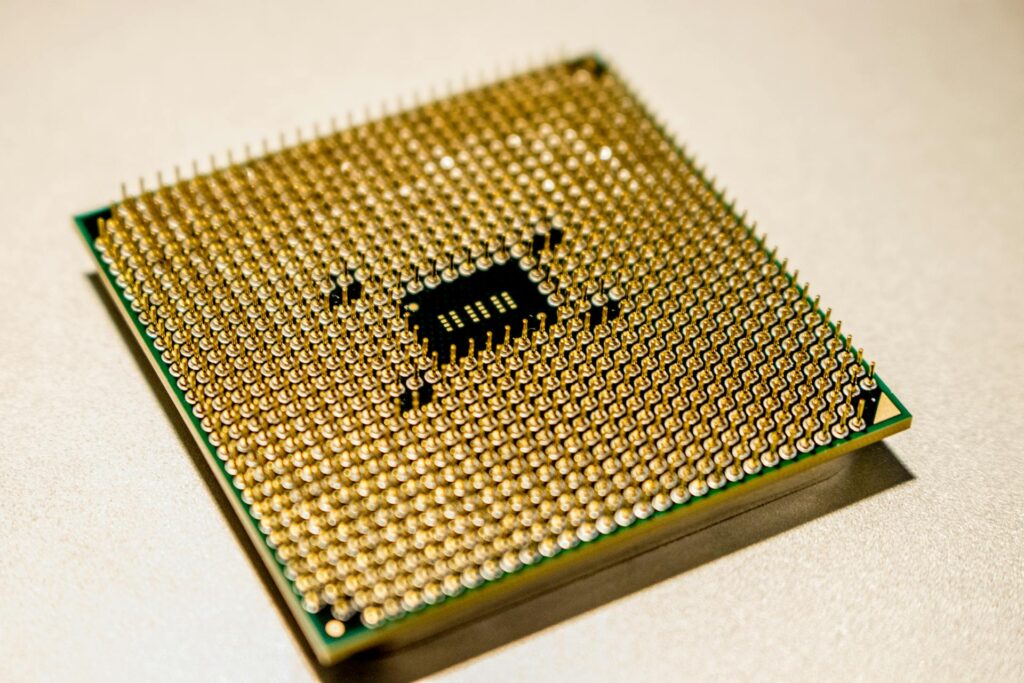
AMD (NASDAQ: bbbbbAMD) – A critical player in supplying processing power for defense applications.
3 – Challenges Facing the AI Semiconductor Industry
A – High Production Costs
Manufacturing AI chips at 3nm or 2nm nodes is extremely capital-intensive, with fab costs exceeding $20 billion per facility.
B – Energy Consumption & Heat Dissipation
AI chips require high processing power, leading to increased power consumption and heat generation.
Potential Solution: Development of energy-efficient architectures such as neuromorphic computing and liquid cooling systems.
C – Supply Chain Disruptions
The industry is heavily dependent on Taiwan (TSMC) and South Korea (Samsung) for chip production.
Potential Solution: Geographic diversification of chip fabrication plants in the US, Europe, and India.

4 – Investment Opportunities
With AI adoption accelerating, there are multiple investment avenues in the semiconductor space:
A – Investing in Leading Semiconductor Companies
| Company | Specialization | Market Position |
| NVIDIA | AI GPUs & NPUs | Market Leader |
| TSMC | Advanced Chip Manufacturing | #1 Foundry |
| Intel | AI & Quantum Computing | Rebuilding Market Share |
| AMD | High-Performance Computing | Fastest Growing |
| TPUs for AI | Proprietary AI Chips |
B – New Business Models & Startups
Fabless Semiconductor Companies (e.g., Graphcore, Cerebras)
Quantum Computing (e.g., IBM, Google, Rigetti)
Edge AI Processing (e.g., BrainChip, Qualcomm)
C – Government & Private Funding
The U.S. CHIPS Act and EU Semiconductor Fund are injecting billions into the industry.
Private investors are backing semiconductor startups to disrupt the market.
5 – Future Projections and Conclusion
AI Semiconductor Market Growth Trajectory
The AI semiconductor industry presents immense opportunities for businesses, researchers, and investors. Companies that focus on performance optimization, energy efficiency, and supply chain expansion will lead the next wave of innovation.
Key Takeaways for Investors:
✔ AI chips are the backbone of the digital revolution
✔ The market is projected to exceed $250 billion by 2030
✔ Investing in semiconductor leaders and startups can yield high returns
✔ Technological breakthroughs will shape the industry’s future
Now is the time to capitalize on AI semiconductor innovation before the next wave of industry breakthroughs reshapes global computing.
“From 3nm to Global Domination: The AI Chip Revolution is Here!” André Rangel

Stay Informed With the Latest & Most Important News
Previous Post
Next Post








Advertisement